





























Up and Over Doors - Inbetween or Behind Installation?
One of the most important decisions when ordering an up and over garage door is deciding where the subframe will sit in the aperture - inbetween your structural brickwork opening or behind (inside) the garage aperture. This single decision dictates your final drive through clearance, your internal parking length, and which door size you need to order.
Because up and over doors kick outward at the bottom as they swing open, your positioning also affects driveway clearance. Retractable doors eventually glide fully back inside the ceiling space, while canopy doors leave roughly one third of the panel protruding outside as a sheltered canopy.
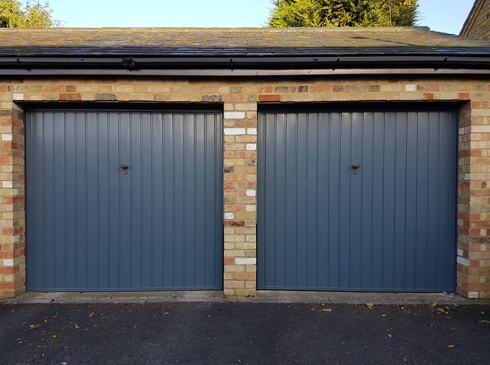 Behind Fit (Fitted to inside brickwork face)
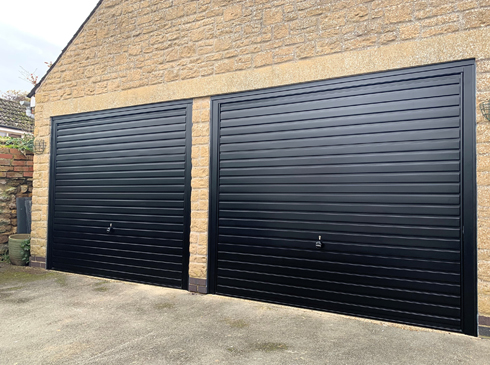 Inbetween Fit (Fitted within brickwork reveals)
1. INBETWEEN FITTING (Installation Within the Reveals)
Fitting inbetween means the entire door panel and its steel subframe sit completely inside the structural brickwork aperture, just like a standard domestic window.
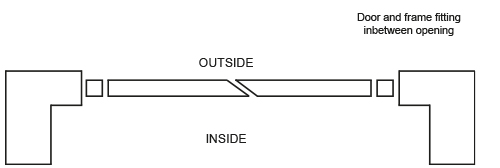
- Advantages: Preserves maximum internal garage length because no frame components project into the room. The door frame can sit flush with the outer brick face or set back 50mm to create an external reveal. Ideal if you have no internal piers or side headroom.
- Disadvantages: Significantly reduces your final drive through width and height. Because the frame uprights (typically 60mm to 75mm per side) sit inside the opening, you lose between 120mm and 150mm of drive through width and more with a retractable mechanism also taking up width space. If you drive a modern SUV or wider estate car, this reduction can make parking difficult.
Inbetween Sizing Examples:
Your Brickwork Aperture: 2400mm wide x 2200mm high.
Standard Off the Shelf Size: A standard 7ft 3in x 7ft 0in door (2210mm x 2134mm ordering size) with a factory fitted 70mm steel frame has an overall outer frame size of 2350mm wide x 2191mm high.
Result: The 2350mm frame fits inside your 2400mm brickwork, leaving a 25mm tolerance on each side to secure with factory installation brackets and seal with matching trim or mastic. However, your clear drive through width is reduced down to 2210mm (and further reduced if using retractable gear).
Made to Measure Alternative: You can eliminate wide frame gaps by ordering a purpose made door (such as our GDO range). For a 2400mm x 2200mm opening, you would deduct a 10mm fitting tolerance (5mm per side) to order an overall frame dimension of 2390mm wide x 2190mm high. The GDO steel sub frame is only 50mm per side so you gain extra precious width here to retain 2290mm width between sub frame
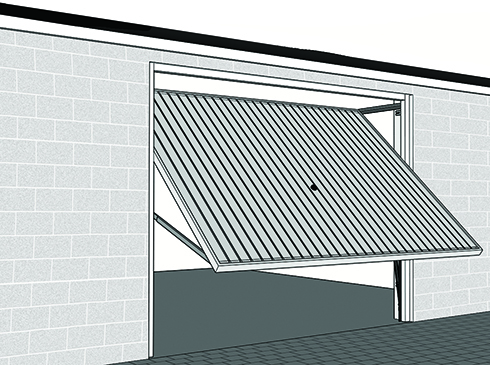
Inbetween Fit: Front View (Retractable Door)
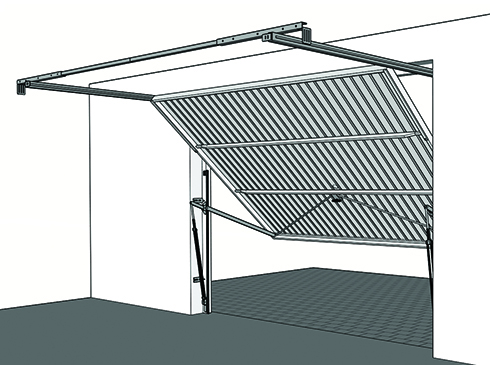
Inbetween Fit: Internal View (Retractable Door)
2. BEHIND FITTING (Installation to the Inside Face)
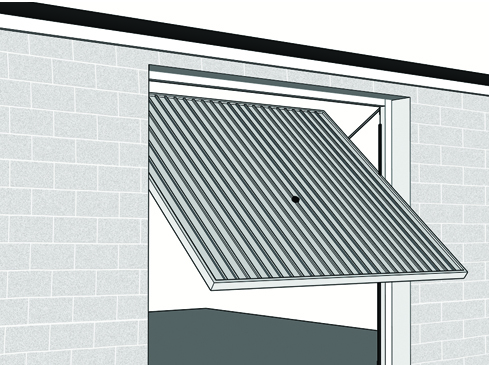
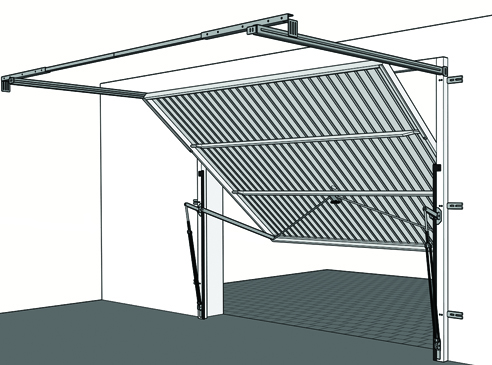
Fitting behind means the steel subframe is anchored directly to the rear face of the brick piers and lintel inside the garage. The door panel swings outward through the masonry opening during travel.
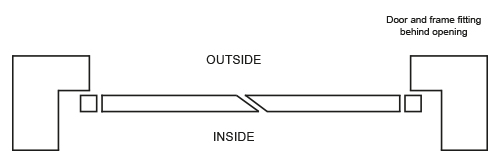
- Advantages: Maximises drive through width and height. Because the upright frame legs hide completely behind your brick piers, your clear opening width matches your full brickwork dimension. It also allows you to fit standard modular size doors to odd-sized openings without expensive custom trimming.
- Disadvantages: Fixing to the inside face reduces internal parking depth by approximately 70mm to 100mm. You must also have sufficient flat return pier space on either side (minimum 75mm) and adequate headroom above the lintel (minimum 70mm to 100mm) to secure the frame.
Behind Sizing Examples:
Your Brickwork Aperture: 2400mm wide x 2200mm high.
Standard Off-the-Shelf Size: A standard 7ft 6in x 7ft 0in door (2286mm x 2134mm ordering size) with a 70mm steel frame has an overall frame dimension of 2426mm wide x 2191mm high.
Result: The 2286mm door panel is narrower than your 2400mm brickwork, so it swings cleanly through the opening without catching. The 2426mm overall frame width overlaps the back of your internal piers by 13mm on each side for fixing. Because the overall height is 2191mm, a small 9mm timber or uPVC trim bridges the top gap to the 2200mm lintel.
Made to Measure Alternative: For an exact behind fit with purpose made sizing, you order the internal frame opening roughly 20mm narrower and 20mm lower than your brickwork (for example, 2380mm x 2180mm). This leaves a 10mm running clearance all the way around so the moving panel never scrapes uneven or out of plumb brickwork.
Behind Fit: Front View (Retractable Door)
Behind Fit: Internal View (Retractable Door)
Why You Need a Factory Steel Subframe
An up and over garage door cannot be fitted directly to brickwork; it requires a structural subframe to carry the pivot brackets, spring anchors, and latches.
We always recommend ordering your door with a factory fitted galvanised steel box-section frame rather than building a timber frame on site:
- Will not twist or warp: Timber subframes can absorb damp, swell, and pinch the door leaf. Steel box sections remain square and stable.
- Better security: Steel latches lock directly into reinforced steel frame keeps, making jemmy attacks much more difficult.
- Pre-fitted hardware: The door panel, springs, and tracks come factory aligned within the steel frame, speeding up installation.
- Matching finish: Steel frames come factory powder-coated to match the door panel or complement woodgrain finishes.
*Profile widths vary between 55mm and 75mm depending on the manufacturer and whether you select canopy or retractable operating gear. Always check the exact outer frame profile before calculating your brickwork clearances.
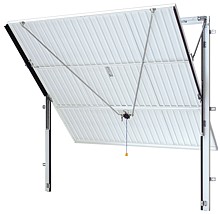 Factory steel box frame pre-assembled to canopy gear.